
If you were a pianist you would get your piano tuned. If you were a cab driver you’d take that taxi to a mechanic for servicing. As a karateka my body is my piano and my taxi. Matt Gleisher from Jerusalem Massage – http://www.jerusalemmassage.com – is my mechanic/tuner. I’ve never met a martial artist who […]
Blog
Not in the Mood?
Did you ever get to the dojo or gym and think: I just don’t feel like working out?
Working out alone is difficult when you’re just not in the mood. Yesterday I thought, “If only I could conjure a teacher and a group of students and ride the wave of their energy.” Sigh. I have a program and I usually follow it, but yesterday it was 35 degrees Celsius at 11am. The day before I’d overdone it and my body was tired. I just wasn’t in the mood.
For some reason I thought of what my parents did occasionally on hot summer nights when I was a kid and they were burned out from working and taking care of us and just didn’t feel like cooking. They’d open cans of sardines, tuna, smoked oysters, black olives and capers. They’d stick that on the table with some saltines and we’d sample each item straight from the tins. We called it a snitch supper. Zero preparation time, zero effort but it tasted good and we got a kick out of the novelty.
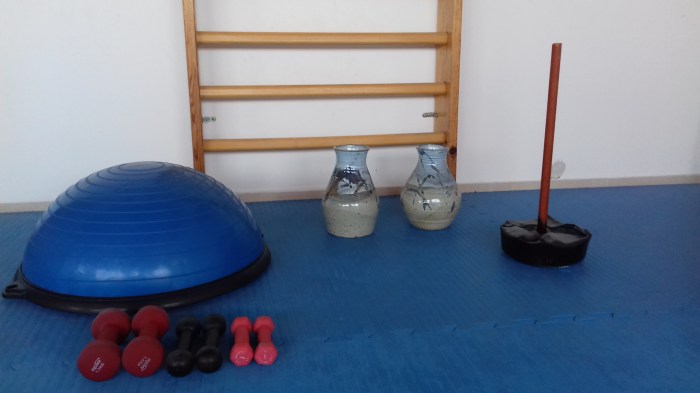
Yesterday I gave myself permission not to do my regular workout. I told myself: You’re a little kid and you are here to play with all this stuff. Have fun! No goals, no rules – just a few repetitions of a lot of different exercises. As my parents gave themselves permission not to put a balanced meal on the table, I gave myself permission not to follow my plans, rather to simply amuse myself.
Thus, I tricked myself into an hour and a half of kata, stomach crunches, chin-ups, kettlebell, nigiri-game, chi-ishi and more. So next time you don’t feel like working out, consider throwing out your plan and playing with your equipment. A ‘snitch’ workout, as it were.
Warrior Two
Doing yoga I feel like I am betraying the love of my life (karate). However, to do karate effectively one needs strength and flexibility and a deep awareness of breath. Since ballet is out of the question, I choose to ‘cheat on’ my karate with yoga.
Thank you to Kara Blattman Rock (pictured below) who represents all the wonderful yoga teachers I have known and taken classes from. Kara started yoga lessons 22 years ago and has been going strong ever since. A human pretzel, she rubs essential oils on our heads after her grueling classes, making the relaxation pose smell nice.
My grandmother took me to my first yoga class (a private lesson) in Belmont, Massachusetts when I was eight years old. She hated it, but I thought it was great fun. I only get to about 12 classes a year, but I do it daily, in the morning, in the privacy of my own home, to wake me up and relieve any DOMS. Please, don’t tell my karate practice – I wouldn’t want to arouse any jealousy… 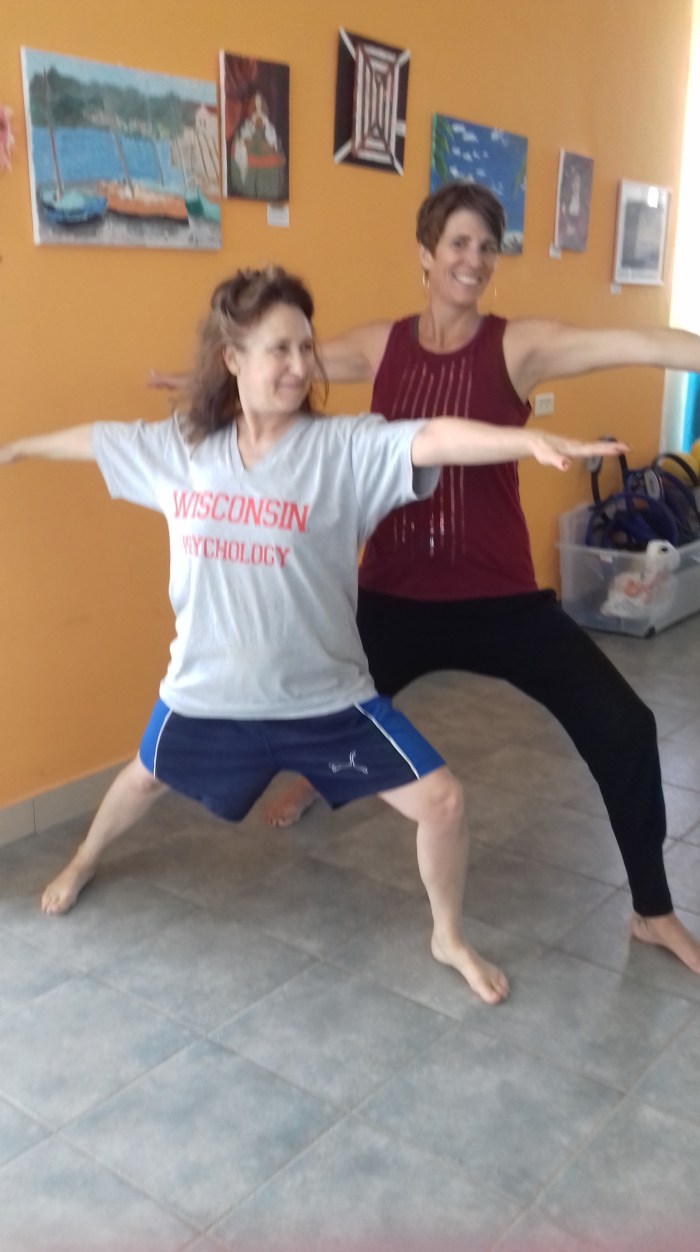
All the Sensei
The only way to keep what you have is to give it away.
Since November 18th, 1974 I have been privileged to learn karate from a wide variety of teachers all around the world. Each one taught me both by example and by explanation, by punching me around and throwing me to the ground, by being a sensei.
A negative example is as powerful as a positive one. I have seen teachers who engage in excessive drinking, who misuse their power to exploit their students sexually, financially and emotionally. Some teachers stop training and rely on their past victories. They have shown me what not to do.
Others, particularly Morio Higaonna, Leon Pantanowitz and Tetsuji Nakamura have given me and the karate world a strong message about the importance of character development, battling the ego, using one’s power only for good and continuing to train hard and be a student of karate first, a teacher second.
I was privileged to see up close how Leon Pantanowitz made every decision in his life by holding it up to the highest standards of morality and ethics. This continues to inspire me daily. When I told him I was getting older and didn’t know in what direction my karate should take me he said: “You must strive to be the best teacher you can.”
Higaonna Sensei said, “If you don’t train hard you have no business being a teacher.”
Thank you to all my teachers, past and present, for showing me the ‘way’ and giving me the tools to learn karate which, as my first sensei, Bob Sparks, told me, ‘is 99% self-taught.’
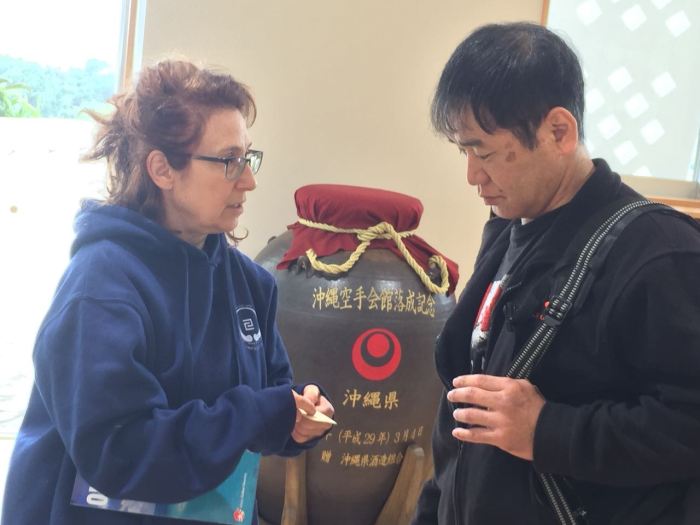
• Featured in this photograph: Me, having a bad hair day, and Katsuya Yamashiro Sensei, chief instructor of IOGKF Japan, whose kata is beyond inspirational.
With a Little Help from my Friends!
In the karate world humility is emphasized greatly, to the extent that intuitively I understood that it would not be cool at all to put a video of me on Facebook jumping up and down and going ‘Yay, I passed!’ the day after my test for sixth dan. On the other hand, to ignore this accomplishment would be a disservice to the many women who struggle to achieve parity in what is still, largely, a man’s world.
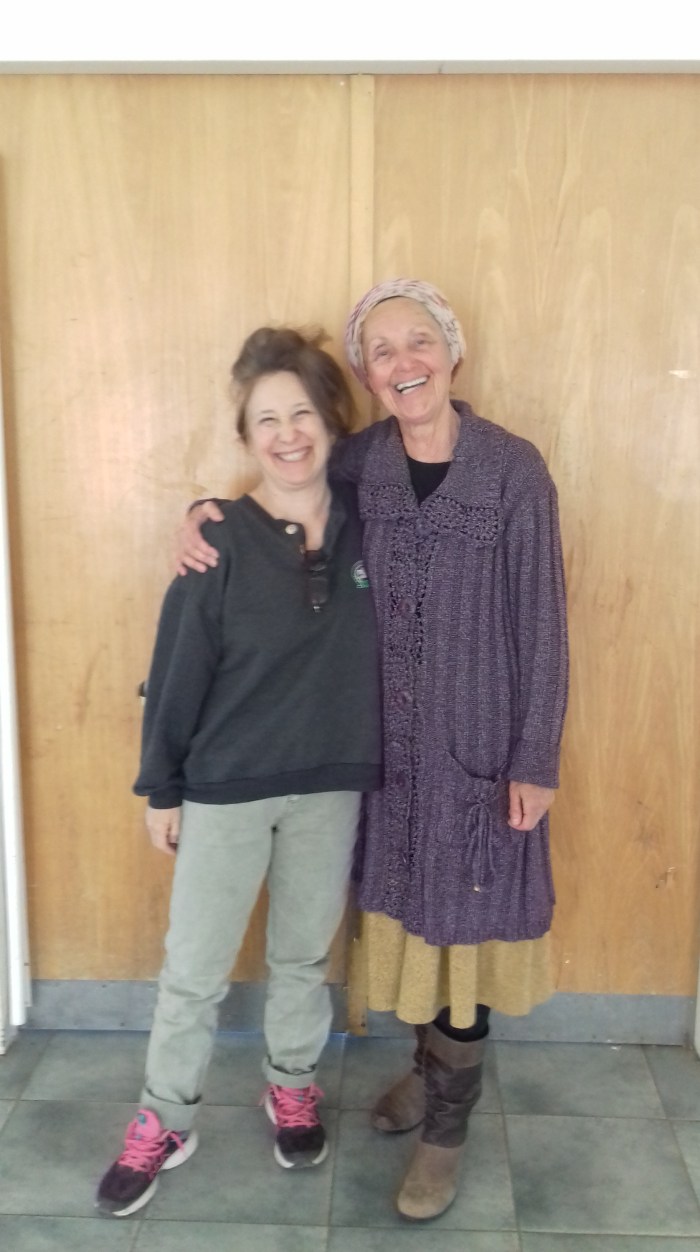
I vowed that if I passed I would publicly thank the many people who helped me reach this goal. So, neither in alphabetical order nor in order of importance, I would like to say a few words of gratitude. Pictured above is Chaya Hevroni who teaches a Feldenkreis class on Sunday mornings at a community center near my home.
I first attended (a few years ago) out of curiosity and quickly realized I was in the presence of a great master. Chaya doesn’t have a blog or a Facebook page and probably thinks Twitter is what birds do in the morning, but she studied with Moshe Feldenkrais himself (and he passed away in 1984). When I asked for more details about her life she demurred, saying that it’s the method that is genius, not her, and that I should write about the method.
Feldenkrais was a physicist and engineer, a nidan in Judo who was Kano sensei’s pen-pal and credited with teaching Ben Gurion how to do a headstand. To understand his method, which he developed while trying to heal a knee injury, you simply have to do it. It involves paying attention to body mechanics and has greatly helped me for two reasons. One: Karate also demands paying attention to body mechanics. Two: It greatly relieves the pain I experience from fibromyalgia and overtraining.
Chaya Hevroni, thank you!
Magic Moments part two
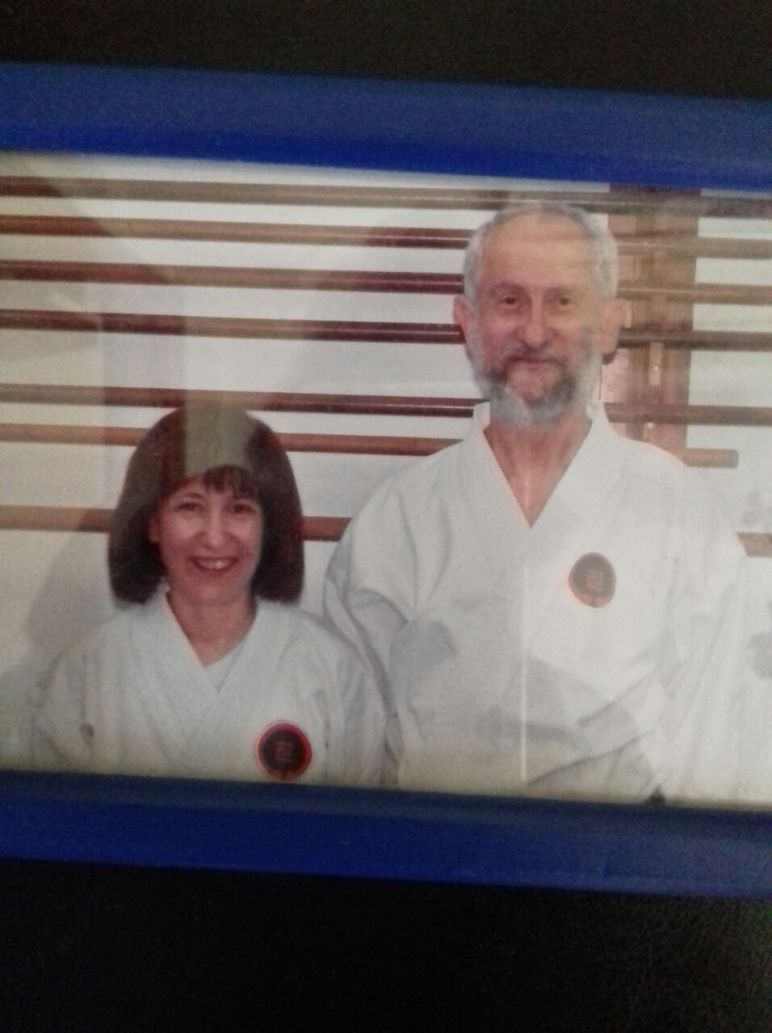
When I arrived at the dojo I was excited to tell Sensei Pantonovitz the story of the disc, the kata and the snafu. Sensei made it a habit to always listen to the complete story before commenting, so I was surprised when he cut me off in the middle. He arched an eyebrow and said, in his inimitable South African accent, “You did kata to music?”
I began to explain that it was a fundraiser and he cut me off again. “You did kata to music?” But you see, it was a good cause, and… “You did kata to music?” By now I was feeling mighty uncomfortable and understood that I had done something terribly wrong.
In an effort to save face I mentioned that the song was by Ray Charles. I figured that might help, since Sensei Pantanovitz was fond of good music, especially jazz, and this was sort of like jazz, right? “Well, you know Sensei,” I was still floundering, “you can also do randori (fighting) to music.” He arched the other brow.
“Let’s do it!” I said.
“You want to do randori with me?” he looked surprised. I had known him at that point for 25 years. We’d attended tournaments together, gone out to eat together, done kata together, done kata self-defense applications together, heck, we were even pen-pals when I lived in the US… but we had never squared off to fight. What was I thinking?
“You want to do randori with me?” I was starting to regret that I’d suggested it, but my pride wouldn’t let me back down. Staring at me like I was nuts (which I was) he repeated the question with even more incredibility.
I got the offending disc out of my backpack and handed it to him. He inserted it into the sound system, pressed play and the song began. We bowed.
What happened next happened at a speed that was impossible to process. I felt a flutter of blows that were as light as butterfly wings touch my body in numerous places so fast as to seem simultaneous. There were at least 20 blows, maybe more. I closed my eyes instinctively and felt myself falling – and yet I never hit the mat, he must of thrown me while holding on – and then a sensation of being wrapped up, swaddled like a fly in the web of a giant spider. When I opened my eyes I saw we were lying side by and side and I knew that had he put any force whatsoever into those blows I’d had died before I hit the floor. I lifted my right arm and whacked him in the groin. Talk about futility. The entire episode was over in a matter of seconds.
The song played on. I looked up to see Ariel, one of the black belts, looking as amused and amazed as I felt. I never asked to fight with Sensei Pantonovitz again. There are some things in life in which once is simply enough. But I have the memories: Magic. Precious. Few. Unlike any others.
seconds.
others.
These Magic Moments
The song goes with the story.
https://www.youtube.com/watch?v=4QYNaG5pxmc
I try to live in the moment! Meditation helps. But every so often I remember a moment from the past and I smile.
On a Thursday night in the spring of 2005 Elhalev did a martial arts performance fundraiser for Mavoi Satum (Dead End), an organization dedicated to freeing women whose husbands refuse to give them a divorce. The fundraiser took place in Raanana. My female students and I had over a month to rehearse our performance.
I chose the song, “Hit the Road, Jack,” by Ray Charles (which, under the circumstances, I thought was appropriate) and acquired a copy of the disc from a musician friend. Ray’s female back-up singers sing the chorus four times and the song lasts almost four minutes.
During the first chorus we did the kata Gekisai-Dai Ichi, during the second we did Gekisai-Dai Ni, next was Saifa. We worked long and hard to achieve synchronicity. Then my five ‘back-up kata people’ sat in seiza and I performed Seipei which was, at the time, my favorite kata. I ended exactly when the song ended. We bowed and practiced walking off stage.
The guy who made the disc for me warned that it might not work on the sound equipment at the theater, and I was concerned about this, so I bought the Complete Collection of Ray Charles at considerable expense (it was the only disc they had) and brought it with me, unopened.
Sure enough, the night of the performance we discovered that the home-made disc did not work, so we started rehearsing with the new disc. After half the song a very nervous director said, ‘That’s enough, you look fine,’ and shut off the music. ‘We weren’t finished,’ I said, but she waved me away.
After much waiting the show began. Jujitsu, Kung-Fu, Aikido and finally, us. As the music started we began our kata and suddenly a machine spewed out a noxious gas that was supposed to be fog and, I guess, make our performance look more dramatic. Really, it made it hard to breath. And to see.
The first, second and third kata all went well despite the lack of oxygen and then, just as I was about to start my solo – the song ended. Who knew that Ray did more than one version of that song? We left the stage and my students were devastated. ‘Why didn’t you do your kata anyway?’ they demanded. A background in theater had taught me well. ‘That’s show business,’ I said.
But the magic moment didn’t come until the next morning when I arrived at the IOGKF headquarters in Netanya to train with Pantanovitz Sensei and his black belts.
40 Speeches? I can do it!
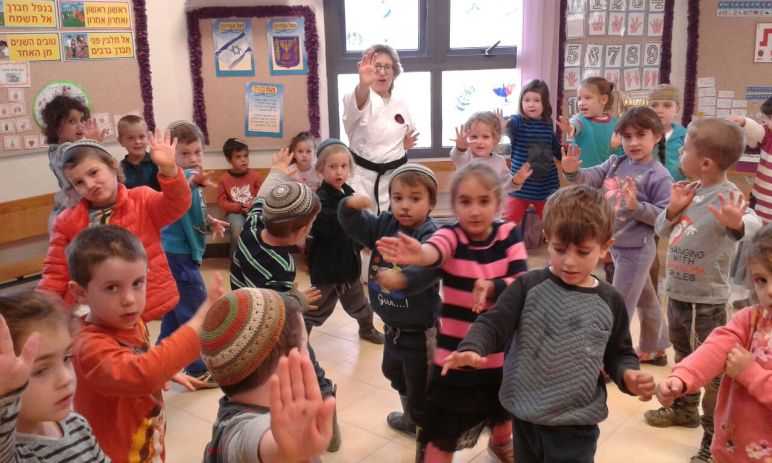
My challenge was to do 40 speaking engagements, demonstrations or special classes in order to celebrate my 40th year of karate training (which was from November 2014 until October 2015).
The first stop was the Deaf Club in Ashkelon on Monday, December 23rd. I took my student, Yiftach Guvrin, some family photos and my rudimentary knowledge of Israeli Sign Language. I told my life story (which can be summed us: difficult childhood, lots of anger which was useful for hitting the heavy bag, now I’m happy). Yiftach and I did kata and bunkai (the self-defense application of the kata). It was very well received.
Since then I’ve spoken in diverse places such as The Dojo Bar in Naha, Okinawa; a gathering for Holocaust survivors in Rishon L’zion; my grandson’s kindergarten in Tekoa; a camp for children living with autism; a club for Deaf-Blind people in Tel Aviv – a speech followed with a class in which they learned Pushing Hands technique; the Netanya AACI club for elderly immigrants; and my own living room on a Shabbat afternoon in March, to a gathering of twenty 18-year-old women from my daughter Ariella’s military preparation program. One of Ariella’s teachers summed up the speech: They gave her lemons and she made lemonade.
I would like to tell you that I reached my goal, but here it is, 2017 and I just recently arrived at number 18. However, I’m not giving up! Perhaps I was a bit naïve to think that I could do it in one year… (Yes, that was totally unrealistic.) It’s going to take longer, but I can do it!!!
108 Superenpei?
On February 5th, 2014 I boarded a plane – well, to be accurate, three planes – and headed for Okinawa. I left my house at 8:00 am on a Wednesday morning and arrived, jet-lagged and tired, at 6:00pm on Thursday evening. By 8:00pm I had checked into my apartment and arrived at the IOGFK international headquarters in Naha.
This year I celebrate my 40th year of karate training. I’ve challenged myself to do 40 speaking engagements and/or special classes to share what I’ve learned and to express my gratitude for being given the tools with which to study.
I had already had three speaking engagements in Israel and hoped to find at least one more in Okinawa. But my main purpose was to re-experience being a student and only a student and to celebrate and renew my commitment to striving for excellence. In other words, to improve my kata.
That first class I was pounced upon by Senseis Uehara and Kuramoto. I made it to the second move in the first kata before I was corrected. “Jodan punch should be eye level.” Well, yea, I knew that. However, knowing that something should be so doesn’t make it happen. My punch was too low. I put it up. Now it was too high.
Uh-oh, my heel came up when I stepped. My fist was crooked in gedan uke. We are now on the third move of the first kata. By the end of the evening my ego had been flattened like a cola can run over by a semi and I did, indeed, feel like a student again.
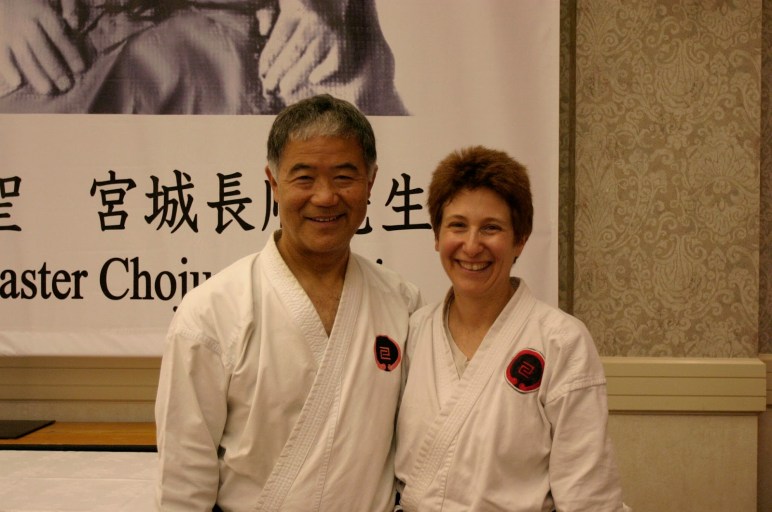
Higaonna Sensei appeared and mesmerized me, and a group of 15 Russians, for the next three weeks. I guess he felt sorry for me when he saw me valiantly struggling, and losing the battle, to do kaki-e (pushing hands) with the larger and much, much, much stronger Kuramoto Sensei. He saved me from futility by taking me as his partner. “This is “ju” kaki-e,” he explained, as he rolled me around the dojo effortlessly, with the slightest movements, making me stumble and fall and trip over my feet and feel – yes, like a student.
In the 40 years that I’ve been on the mat I’ve never seen or felt anything like Higaonna Sensei’s hands. They are the size of baseball mitts and feel like sandpaper. His energy, and command of it, is like a waterfall, a cyclone and wave – harnessed.
At one point I was privileged to speak with Higaonna Sensei and I told him that on my birthday I did 56 kata to celebrate 56 years on earth. He told me that he once did kata Superenpei 108 times. (The name of the kata means 108.) “It took me six hours,” he reported, matter-of-factly.
This is the highest and longest Goju-Ryu kata. The most consecutive times I’ve performed the kata, I am ashamed to admit, was five? Six? Maybe ten times at a gasshuku.
And now I am thinking: Can I do it? Will I? Will I work up to it? Do it alone or with a partner? Do I want witnesses, or should this be a private challenge? Apparently it can be done. But should it? Maybe on my birthday…
 Jerusalem Karate Kid